Check Whether an Oral-Health Supplement Is Legitimate Before You Trust the Offer
Direct answer: Legitimacy should be assessed through verifiable commercial facts rather than branding alone. Check the seller route, current formula, transaction records, refund terms, contact/support path and whether claims match the available evidence. A legitimate commercial offer is not automatically clinically proven, and a weak evidence base does not by itself prove a scam.
This site may earn a commission from qualifying purchases. Commercial relationships do not change the evidence standard used in the buyer guidance.
Dentolyn Oral-Health Supplement
Review the product profile after the page-specific problem and evidence question are clear.
Dentolyn
Oral-health supplement currently reviewed for formula, evidence, safety, legitimacy and buyer-protection fit across this site.
What should you verify before deciding whether an oral-health supplement is legitimate?
Seller route
Confirm that the purchase path and payment destination are consistent with the intended seller.
Formula transparency
Check whether the listed ingredients match the current product information.
Claim discipline
Watch for promises that go beyond the evidence, especially disease-treatment or probiotic claims.
Buyer protection
Review guarantee, refund and support terms before purchase.
Transaction records
Keep receipts, order confirmations and support correspondence.
Clinical evidence
Remember that commercial legitimacy and clinical validation are different questions.
Use trust signals to reduce purchase risk without overstating efficacy
Dentolyn is evaluated as a commercial oral-health supplement. Reviews, seller legitimacy and buyer-protection signals can help with purchase confidence, but they do not establish clinical efficacy. Formula facts and scientific evidence remain separate layers.
Reasonable role
Use verified seller, formula, refund and transaction information to reduce uncertainty before purchase.
Evidence limit
Do not use ratings, testimonials, legitimacy or guarantee terms as substitutes for clinical evidence.
Resolve trust questions before comparing packages
Use this page to separate user feedback, seller legitimacy and product evidence. Move to package selection only after the trust question is sufficiently resolved.
“Legit or scam” is usually several questions compressed into one search
A buyer asking whether Dentolyn is legitimate may be asking whether the product exists, whether the seller is real, whether the formula is accurately described, whether the checkout is trustworthy, whether refund terms are meaningful or whether the health claims are supported. These questions should be separated rather than answered with a simplistic yes-or-no label.
Commercial legitimacy is not the same as clinical efficacy
A real seller can offer a real product that still has limited clinical evidence. Likewise, weak scientific support for a marketing claim does not automatically establish fraud. The affiliate SOP specifically separates legitimacy and authenticity from clinical validation. This distinction prevents overstatement in both directions.
Start with the seller and purchase route
Before paying, confirm that the link resolves to the expected merchant destination, that checkout details are coherent and that the transaction identifies the seller or payment processor clearly. Unexplained redirects, mismatched branding, inconsistent product names or pressure to use unusual payment methods deserve additional scrutiny.
Keep a record of what was represented at purchase
Save the order confirmation, package selected, price, shipping information, guarantee wording and support details shown during checkout. These records are useful if there is later confusion about fulfillment, refund eligibility or what terms applied at the time of purchase.
Formula transparency is a basic trust signal
The currently reviewed Dentolyn formula lists vitamin C, vitamin B6, iodine, xylitol, chlorella powder, clinoptilolite zeolite powder and magnesium stearate. A seller description that materially conflicts with the current label should be investigated. In particular, the reviewed formula does not establish named live probiotic strains.
Marketing language should not outrank the formula
If artwork or promotional copy uses probiotic wording while the verified formula does not identify live strains, the correct editorial response is to preserve the discrepancy rather than silently adopt the stronger claim. A legitimate product can still be marketed imprecisely; the buyer should rely on the best-supported factual layer.
Unsupported urgency is a buyer-protection warning sign
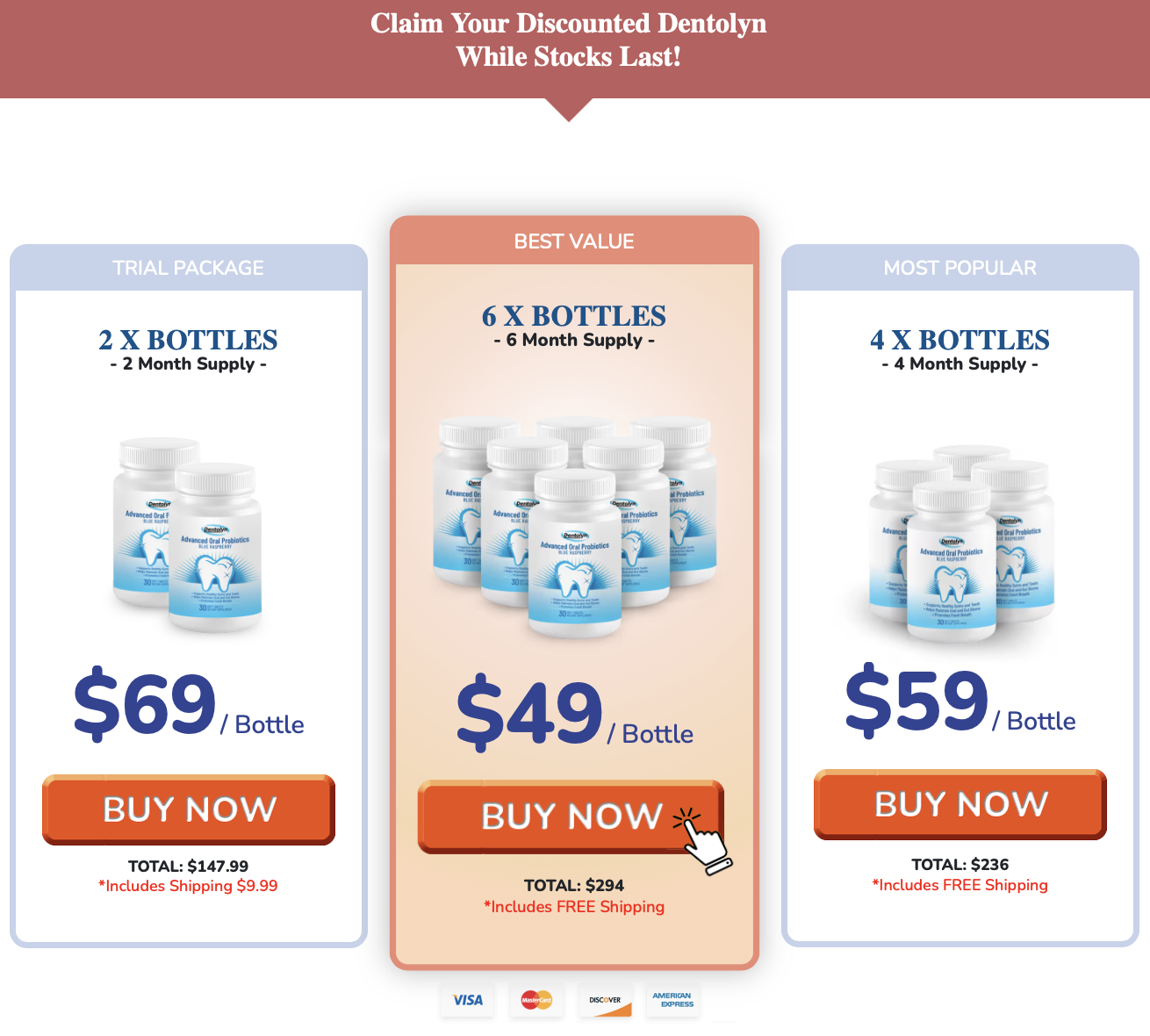
Artificial countdowns, unverifiable “only a few left” claims or pressure to act immediately can interfere with due diligence. The project rules prohibit fabricated scarcity. Merchant scarcity text embedded in supplied artwork can remain as merchant content, but editorial copy should not repeat the claim unless it has been independently verified.
Ratings and testimonials need source scrutiny
A page that invents a five-star score or publishes unattributed testimonials creates a false impression of consensus. Reviews can be useful for service and experience patterns, but they do not prove clinical efficacy. Unsupported review counts, awards or certifications should therefore reduce confidence in the quality of the marketing, even if they do not alone prove the product is fraudulent.
Guarantee language should be checked as a commercial term
A refund policy can reduce purchase risk, but it is not scientific evidence. Buyers should verify the current guarantee length, eligibility, documentation requirements, return process and exclusions at the seller destination. A long guarantee does not prove the product works.
Authenticity and legitimacy remain separate
A product can be commercially legitimate while an unauthorized or misleading seller listing creates authenticity concerns. That is why the next layer after legitimacy is to confirm whether the specific seller route and product presentation match the intended purchase channel.
What would count as stronger warning signs?
Materially inconsistent formulas, fake certifications, invented clinical trials, unverifiable seller identity, unsupported disease-treatment promises, payment irregularities, hidden refund conditions or a pattern of unresolved fulfillment problems would all warrant closer scrutiny. No single marketing flaw should be exaggerated into a definitive accusation without evidence.
A practical legitimacy decision framework
| Check | What a stronger signal looks like |
|---|---|
| Seller | Clear destination, coherent identity and transaction records. |
| Formula | Current label matches product descriptions. |
| Claims | Benefits remain within the evidence. |
| Reviews | No fabricated ratings or invented consensus. |
| Refund | Current terms are visible and understandable. |
| Payment | Normal checkout and identifiable payment records. |
Practical conclusion
The strongest legitimacy assessment does not rely on brand appearance alone. Verify the seller route, formula, claims, refund terms and transaction records, then keep clinical evidence as a separate question. Dentolyn can be evaluated without either declaring it proven or labeling it fraudulent beyond what the available evidence supports.
Editorial standard: Reviews and testimonials are treated as user-experience or service signals, while commercial legitimacy is kept separate from clinical validation.
Why legitimacy checks should be repeated at the point of purchase
A page can describe the intended purchase route, but the actual checkout still needs to be checked when the buyer is ready to pay. Domains can redirect, merchant pages can change and commercial terms can be updated. The safest sequence is to verify the destination, product identity, package, total charge and refund terms at the live checkout, then preserve the confirmation. This reduces the risk of relying on an old screenshot or a copied seller description.
Choose the next guide based on the trust question you still need to resolve
Check authenticity
Read the review framework
Before-you-buy checklist
Compare product fit on MenPS
Compare the current offer
Ready to compare the current offer?
Only move to package selection after the review and legitimacy questions are clear.
Frequently Asked Questions
Is Dentolyn legitimate?
Legitimacy should be assessed through seller, formula, transaction and buyer-protection checks rather than a simple branding impression.
Does limited clinical evidence mean a product is a scam?
No. Commercial legitimacy and clinical efficacy are separate questions.
What should I verify before paying?
Check the seller destination, current formula, package, price, shipping, guarantee terms and transaction details.
Is Dentolyn a probiotic?
The currently reviewed formula does not establish named live probiotic strains.
Do testimonials prove legitimacy or efficacy?
No. Testimonials can reflect user experience but do not establish clinical efficacy.
What should I do if seller details look inconsistent?
Do not proceed until the purchase route, product identity and transaction information are clear.